Garden of Net Master (Wangshiyuan)
The Master of the Nets Garden (in Chinese: 网师园), aka Garden of the Master of the Fishing Nets or Wangshi Garden, is the smallest among Suzhou’s famous classical gardens, such as the Humble Administrator's Garden, the Lingering Garden, and the Lion Grove. Despite its size, it is still the most impressive, thanks to the architect who used its limited space smartly to create the illusion of a much larger area.
It was officially placed on the World UNESCO Heritage list in 1997 — but honestly, it already felt world-class long before that. For anyone planning to travel in Suzhou, this garden is one of the top sites to visit.
Master of the Nets Garden Facts
Master of Nets Garden History
The history of the UNESCO-listed Master of the Fishing Nets Garden stretches back over 800 years to the Southern Song Dynasty. It was originally part of a scholar-official’s residence built by Shi Zhengzhi, a high-ranking official and passionate book collector. After retiring to Suzhou, he named this Song dynasty garden “Yuyin,” meaning “living like a fisherman,” showing his desire to step away from official life.
During the Qing Dynasty, Song Zongyuan rebuilt the site and renamed it the “Master of the Nets Garden”. Later, a wealthy merchant, Qu Yuancun, gave the garden its most important transformation, adding star attractions like Late Spring Studio and Pavilion for the Advent of the Moon and Wind that still attract tourists’ attention on their Suzhou tours in China.
Master of the Nets Garden Layout & Spatial Design
Covering about 10 mu, the size of the Master of the Nets Garden is quite small compared with many classic Chinese gardens. When you walk in the garden’s corridors, through the windows, you often catch views of beautiful flowers or plants in the distance. It is divided into three sections: the residential quarters, the central garden, and the inner garden.
On the eastern side, the old living quarters — the Wanjuan Hall and Xiexiu Tower — are lined up in tidy north-south courtyards, peaceful and uncluttered. As for the central section, everything opens up around Cai Xia Pond. Pavilions sit naturally by the water in a way that shows traditional Chinese landscaping at its best. The western inner garden is the quietest of all, centered on the Late Spring Studio. It’s tucked away behind bamboo and banana trees, feeling like a total secret garden.
Must-See Attractions in the Garden of Master of Nets
Cai Xia Pond
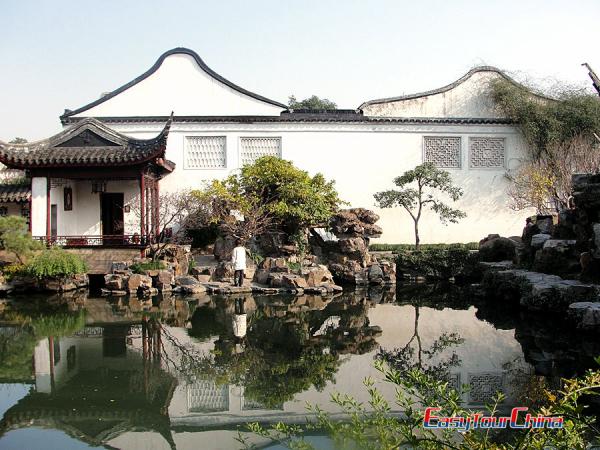
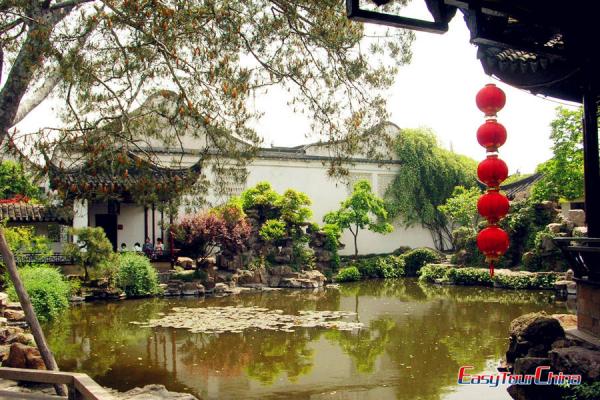
This is the center of the Master of the Nets Garden in Suzhou, and everything seems to circle around it. The pond is square and surprisingly open, especially for such a small garden. On a clear day, the sky reflects perfectly on the water, making the space feel much bigger than it actually is.
Pavilion for the Advent of the Moon and Wind
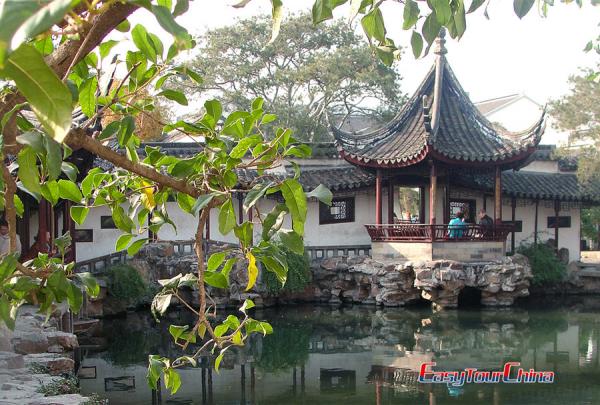
The name comes from a Song Dynasty poem. With water on three sides, this pavilion is famous for moon viewing, especially during the Mid-Autumn Festival. On the right night, you can see the moon in the sky, its reflection in the pond, and even in the pavilion’s mirrors — three moons in one view.
Yin Jing Bridge
Often called the smallest stone arch bridge in the world, this bridge of the Master of the Nets Garden is only about 2.4 meters long and less than a meter wide. You can cross it in three steps, yet it has all the classic details — stone rails, steps, and a perfect little arch.
Ribbon Washing Pavilion
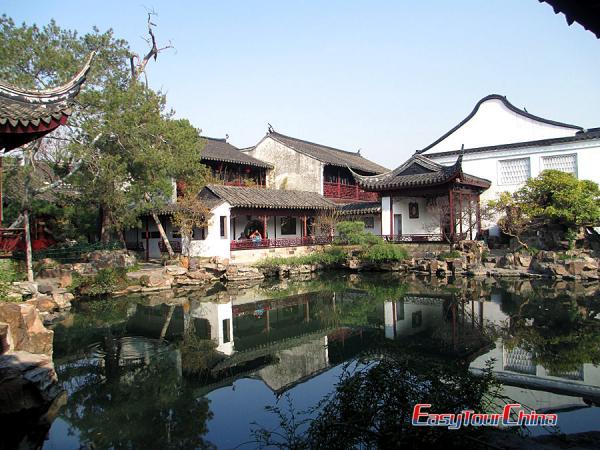
This waterside pavilion stretches along nearly a third of the southern shore. It’s one of the larger structures in the Garden of the Master of Nets. Built right over the water, it almost seems to float, blurring the line between land and pond.
Late Spring Studio
As the original blueprint of the famous Astor Court at the Metropolitan Museum of Art in New York, this site allows you to experience the original version of it right here. Often described as a “garden within the garden,” the stone paving here in the Master of the Nets Garden is laid out like a fishing net. In the 1930s, famous painter Zhang Daqian lived here with his brother, using this quiet space as his studio. Even now, it still feels like a place made for artistic inspiration.
>> Recommended 2-day Suzhou culture tour
Master of the Nets Garden Tour Route
The Garden of Master of Nets is easy to explore, and below is a classic route to tour it.
Route: Entrance → Gate Hall → Sedan Hall → Wanjuan Hall → Xiexiu Tower → Wufeng Study → Jixu Studio → Bamboo Pavilion → Pine-Viewing Studio → Late Spring Studio → Lengquan Pavilion → Pavilion for the Advent of the Moon and Wind → Ribbon Washing Pavilion → Yin Jing Bridge → Porcelain Hall → Exit
Master of the Nets Garden Night Tour
The night tour is when the Master of the Nets Garden feels completely different from the daytime. Once the sky gets dark, the crowds thin out, the lights come on, and the whole place slows down. As you wander around, performances appear naturally along the way, turning the entire space into a living stage of Jiangnan culture.
Master of the Nets Garden Night Show
Tip: The shows run on a loop, so just follow the guide or the flow of people, and you won’t miss much.
>> Recommended 3-day Suzhou tour + night visit to Master of the Nets Garden
Best Photo Spots in the Garden of Master of Nets
If you’re even mildly into photography, the Master of the Nets Garden in China delivers — effortlessly. Below are the best sites to snap beautiful photos in this garden.
- Yin Jing Bridge – Any angle works, with pavilions and greenery as your backdrop.
- Pavilion for the Advent of the Moon and Wind – Visit late afternoon; soft light makes for effortless cinematic shots.
- Late Spring Studio – Peonies, stone paths, and traditional Chinese architecture; perfect for hanfu “time travel” photos.
- Ribbon Washing Pavilion – Built over the water, it gives reflections, open sky, and garden architecture in one frame.
- Bamboo Pavilion – Slender bamboo sways outside, making every shot feel light and elegant.
Best Time to Visit the Master of Nets Garden
The Master of the Nets Garden is beautiful in every season, and you'll be amazed whenever you visit. Spring brings magnolias, crabapple blossoms, and peonies, with fresh green climbing over stone bridges. Summer is all about lotus leaves on the pond and the cool relief of the night garden. In autumn, the clear water contrasts with red maples and golden vines, creating a breathtaking view. Winter is the calmest, with subtle plum blossom fragrance, snow-dusted pines, and far fewer visitors.
If you want the garden at its most atmospheric, spring mornings or summer night tours are hard to beat.
>> Read more about Suzhou’s Climate & Weather
How to Get to the Garden of the Master of the Fishing Nets
Get to the Master of the Nets Garden from Other Parts of Suzhou
By Metro
Take Metro Line 4 to Sanyuanfang (Exit 4) or Line 5 to Nanyuan North Road (Exit 4).
By Bus
Take Bus Routes 202, 529, 931, 9003, or 9006, and get off at Wangshi Garden stop.
By the way, Pingjiang Road is about 3 km from the garden. From there, a quick taxi ride or shared bike will get you to the garden in around 10–15 minutes.
Get to the Master of the Nets Garden from Shanghai
Hop on a high-speed train from Shanghai to Suzhou Railway Station. From there, take Metro Line 4 to Sanyuanfang Station, using Exit 4. Then, walk for about 10 minutes to the Garden of the Master of Nets.
>> Recommended 3-day Shanghai highlights tour with the Master of the Nets Garden
Tour Master of the Nets Garden with ETC
Master of the Nets Garden is not to be missed on your Suzhou tours. If you want to see the city like a local rather than just another tourist, consider exploring the garden and other Suzhou attractions with Easy Tour China, a local travel expert with over 20 years of experience in tailor-made China tours. Below are our popular China tour packages with Suzhou.
Looking for a customized Suzhou tour? Feel free to contact us.
More Attractions in Suzhou